
Lecture 08: Creating Tables and Constraints
DATA 351: Data Management with SQL
February 16, 2026
The Big Picture 🚁
From Blueprint to Building
Last time we learned to normalize data. That was the blueprint. Today we pour the concrete.
Today’s Agenda
We are learning DDL (Data Definition Language) to implement your normalized designs:
- 🏷️ Naming conventions (the surprisingly heated topic)
- 🔑 Primary keys (natural vs surrogate)
- 🔗 Foreign keys (relationships between tables)
- ✅ CHECK, UNIQUE, and NOT NULL constraints
- 🔧 ALTER TABLE (because nobody gets it right the first time)
- ⚡ Indexes (making queries go brrr)
Our Running Example: A Music Catalog 🎧
The Scenario
You work for a streaming service that just acquired a catalog of albums from a defunct record distributor. The data arrived as a single CSV spanning six decades of music, from Fleetwood Mac to Beyonce.
Your job: normalize it and build proper tables.
The Messy Data
Here is a sample of what you received:
| catalog_id | artist_name | album_title | release_year | genre | label | duration_min |
|---|---|---|---|---|---|---|
| CAT-1001 | Fleetwood Mac | Rumours | 1977 | Rock | Warner Bros | 39.4 |
| CAT-1003 | The Beatles | Abbey Road | 1969 | Rock | Apple | 47.4 |
| CAT-1004 | The Beatles | Abbey Road | 1969 | Rock | Apple | 47.4 |
| CAT-1005 | Led Zepplin | Led Zeppelin IV | 1971 | Rock | Atlantic | 42.5 |
| CAT-1006 | Beyonce | Lemonade | 2016 | R&B | Columbia | 45.7 |
| CAT-1009 | the rolling stones | Sticky Fingers | 1971 | Rock | Rolling Stones | 46.3 |
| CAT-1012 | Outkast | Aquemini | 1998 | Hip-Hop | LaFace | 72.6 |
Duplicates, typos, inconsistent casing… this data has seen things. 😬
The Normalized Target
After normalization, we want three clean tables:
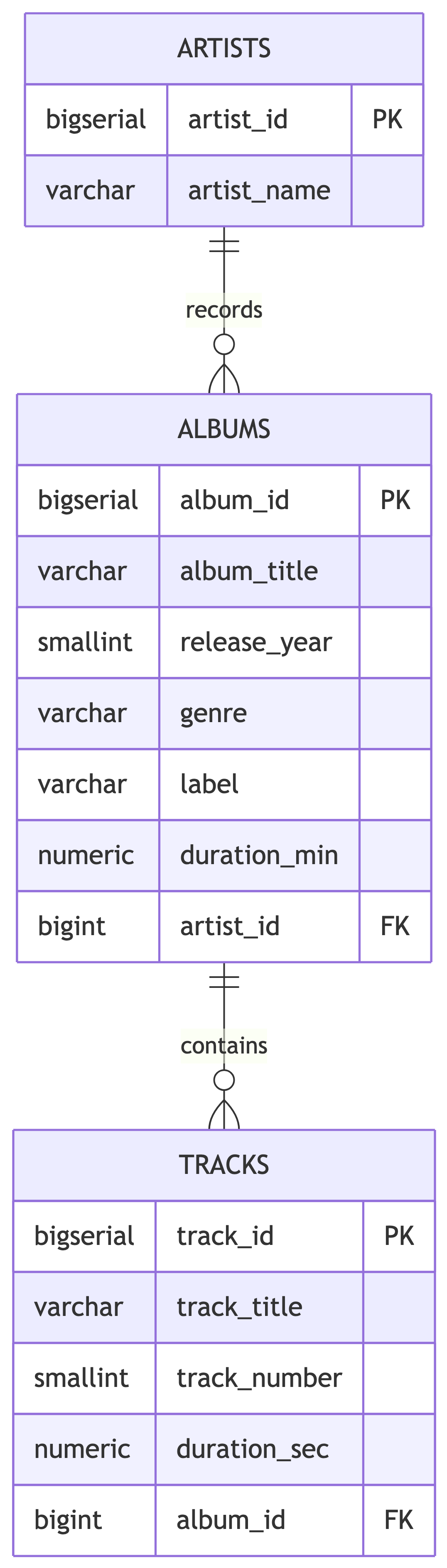
Today we learn how to build these tables. Next time we fill them.
Naming Conventions 🏷️
Why Naming Matters
Good naming makes your database self-documenting. Bad naming leads to:
- Confusion when writing queries
- Bugs from misremembering column names
- Onboarding headaches for new team members
- Passive-aggressive comments in code reviews
Your future self is a team member. Be nice to them. 😉
PostgreSQL Naming Rules
PostgreSQL identifiers (table and column names):
- Can contain letters, digits, and underscores
- Must begin with a letter or underscore
- Are case-insensitive by default (folded to lowercase)
- Maximum length of 63 characters
PostgreSQL treats your SHOUTING the same as your whispering. 🤫
The Double-Quote Trap 🪤
If you use double quotes, the name becomes case-sensitive:
Warning
Avoid double-quoted identifiers. They create maintenance headaches because every query must match the exact casing with quotes. You will curse your past self at 2 AM.
Best Practices
| Convention | Example | Avoid |
|---|---|---|
| Use snake_case | release_year |
releaseYear, ReleaseYear |
| Be descriptive | artist_name |
art_nm |
| Use plurals for tables | artists, albums |
artist, album |
| Include units | duration_min |
duration |
| Prefix dates | report_2026_01_15 |
15_01_2026_report |
Tables are collections, so plural. Columns are attributes, so singular and descriptive.
🧠 Knowledge Check 1
Which table name follows PostgreSQL best practices?
"AlbumData"album_dataalbumdataAlbum-Data
Think about: Why is your answer the best choice?
✅ Answer: Knowledge Check 1
B) album_data
Snake_case, lowercase, descriptive, no quotes needed.
Primary Keys 🔑
What Is a Primary Key?
A primary key uniquely identifies each row in a table. It guarantees:
- Uniqueness: No two rows share the same key value
- Non-nullability: The key cannot be NULL
- Identity: A reliable way to reference a specific row
Every well-designed table should have one.
Two Flavors of Primary Keys
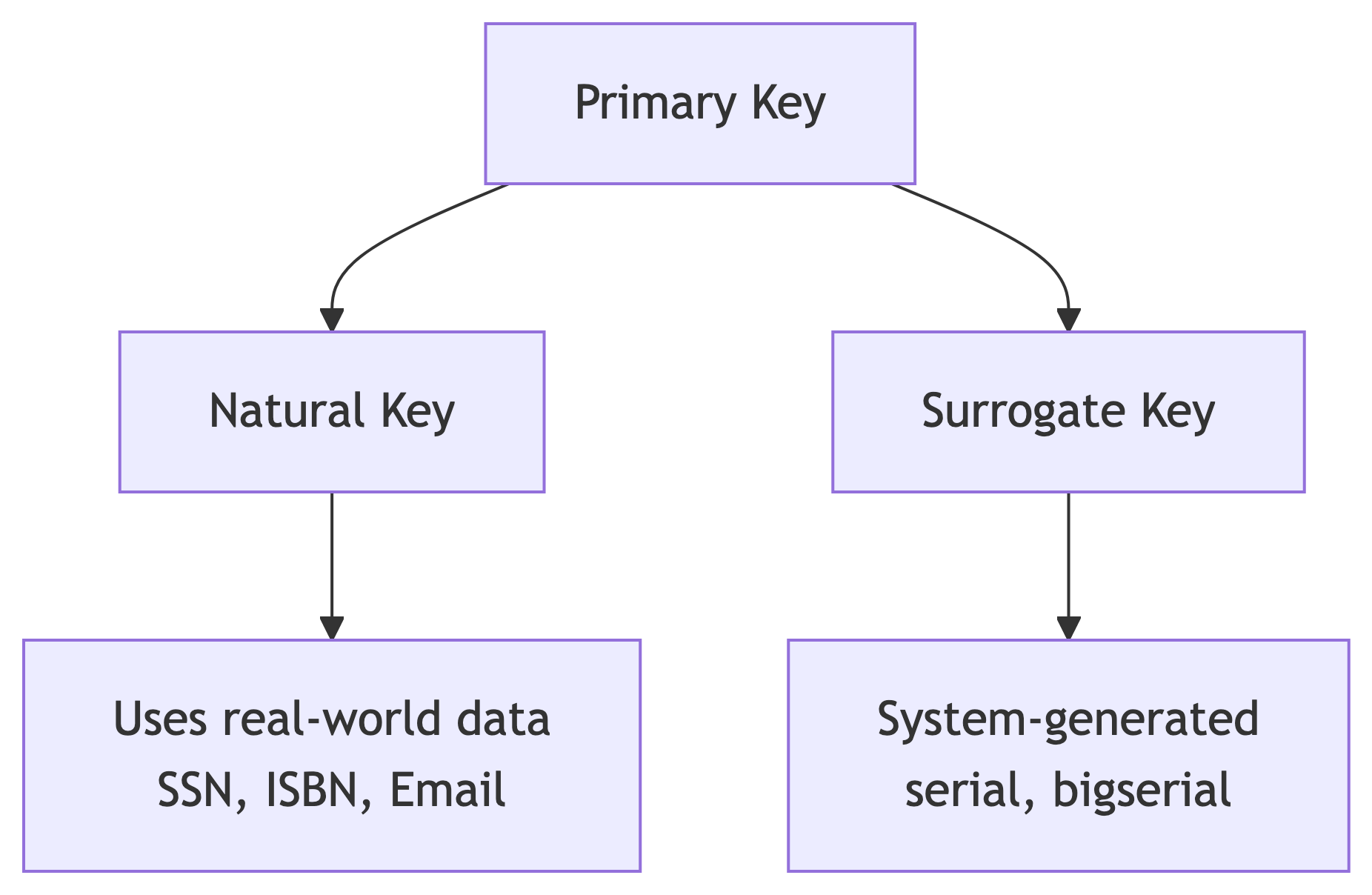
Natural Keys
A natural key uses data that already exists and naturally identifies the entity:
Each person has exactly one license number and it is unique. In theory. In practice, natural keys have a habit of being less unique than you were promised.
Natural Keys: What Happens with Duplicates?
The second INSERT fails:
ERROR: duplicate key value violates unique constraint "license_key"
DETAIL: Key (license_id)=(T229901) already exists.
The database is polite about it, but firm. 🚫
Composite Natural Keys
Sometimes no single column is unique, but a combination is:
A student can only have one attendance record per day. Neither column is unique alone, but together they form a unique identifier.
Surrogate Keys
A surrogate key is a system-generated value with no real-world meaning:
PostgreSQL auto-generates incrementing integers:
| Type | Range |
|---|---|
smallserial |
1 to 32,767 |
serial |
1 to ~2.1 billion |
bigserial |
1 to ~9.2 quintillion |
Surrogate Keys in Action
artist_id | artist_name
-----------+---------------
1 | Fleetwood Mac
2 | The Beatles
3 | BeyonceWe never specified artist_id. PostgreSQL handled it. One less thing to argue about. 🎉
Natural vs Surrogate: When to Use Which
| Factor | Natural Key | Surrogate Key |
|---|---|---|
| Meaning | Has real-world meaning | Meaningless identifier |
| Stability | Can change (email, name) | Never changes |
| Size | Varies (could be long) | Fixed, compact |
| Performance | Depends on data type | Fast (integer) |
| Universality | Not always available | Always available |
Tip
Rule of thumb: Use surrogate keys (bigserial) for most tables. If a natural key is truly stable (ISBN, SSN), consider it. When in doubt, surrogate wins.
Two Syntax Styles
Best for single-column keys.
🧠 Knowledge Check 2
You are building a table to store student grades per course. Which primary key strategy works best?
Use the student’s email as a natural key
Use a composite key of
(student_id, course_id)Use a
bigserialsurrogate key and a UNIQUE constraint on(student_id, course_id)Use the student’s name as a natural key
Think about: Why does your answer handle the real-world better than the others?
✅ Answer: Knowledge Check 2
C) Use a bigserial surrogate key with a UNIQUE constraint on (student_id, course_id)
A surrogate key is stable, and the UNIQUE constraint still prevents duplicate enrollments.
Foreign Keys 🔗
Connecting Tables
A foreign key is a column in one table that references the primary key of another. It enforces referential integrity: you cannot reference a row that does not exist.
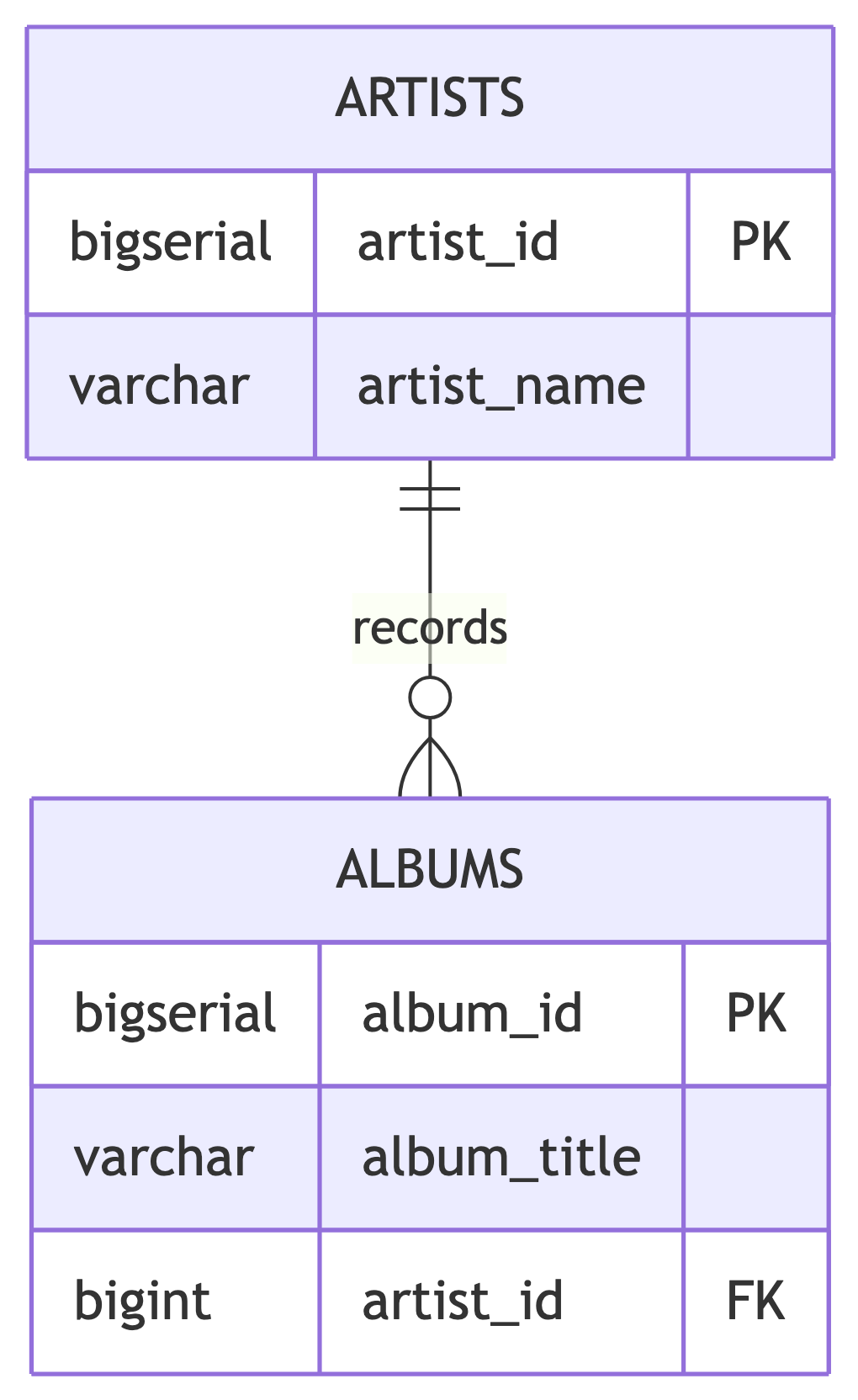
Creating Foreign Keys
CREATE TABLE artists (
    artist_id bigserial,
    artist_name varchar(200) NOT NULL,
    CONSTRAINT artist_key PRIMARY KEY (artist_id)
);
CREATE TABLE albums (
album_id bigserial,
album_title varchar(200) NOT NULL,
release_year smallint,
artist_id bigint REFERENCES artists (artist_id),
CONSTRAINT album_key PRIMARY KEY (album_id)
);The REFERENCES keyword creates the contract: “This value must exist in the other table.” The database holds you to it. 🤝
Referential Integrity in Action
ERROR: insert or update on table "albums" violates foreign key
constraint "albums_artist_id_fkey"
DETAIL: Key (artist_id)=(999) is not present in table "artists".
What Happens When You Delete a Parent?
By default, PostgreSQL prevents deleting a parent row if children reference it.
ON DELETE CASCADE auto-deletes children when the parent is removed:
Delete an album and all its tracks vanish with it. 💨
ON DELETE Options
| Option | Behavior |
|---|---|
RESTRICT (default) |
Prevent deletion if children exist |
CASCADE |
Delete children automatically |
SET NULL |
Set foreign key to NULL in children |
SET DEFAULT |
Set foreign key to default value |
Warning
Use CASCADE carefully. Deleting one artist could cascade through albums and tracks, removing far more data than intended. CASCADE is the database equivalent of pulling a loose thread on a sweater. 🧶
🧠 Knowledge Check 3
You have an orders table with a foreign key to customers. A customer wants to delete their account, but they have existing orders. What does the DEFAULT behavior do?
Deletes the customer and all their orders
Deletes the customer and sets
customer_idto NULL in ordersPrevents deleting the customer
Deletes the customer but keeps the orders unchanged
Think about: Why is this the safest default?
✅ Answer: Knowledge Check 3
C) Prevents deleting the customer
The default is RESTRICT. It protects data by refusing to leave orphan rows.
CHECK Constraints ✅
Validating Data at the Gate
A CHECK constraint ensures column values meet a condition. If the condition is false, the row is rejected. No exceptions. No bribes. 🚨
CREATE TABLE albums (
    album_id bigserial,
    album_title varchar(200) NOT NULL,
    release_year smallint,
    duration_min numeric(5,1),
    CONSTRAINT album_key PRIMARY KEY (album_id),
    CONSTRAINT check_year_range
        CHECK (release_year BETWEEN 1900 AND 2100),
    CONSTRAINT check_duration_positive
        CHECK (duration_min > 0)
);
CHECK: Practical Examples
-- Genre must be from a known list
CONSTRAINT check_genre
    CHECK (genre IN ('Rock', 'Pop', 'Hip-Hop', 'R&B',
           'Country', 'Electronic', 'Alternative', 'Jazz'))

-- Track number must be positive
CONSTRAINT check_track_positive
    CHECK (track_number > 0)

-- Duration must be within reason (no 2-hour tracks)
CONSTRAINT check_duration
    CHECK (duration_sec BETWEEN 1 AND 7200)
Tip
CHECK constraints catch bad data at the database level, regardless of which application inserts it. Applications come and go, but the database remembers. 🐘
UNIQUE Constraints 🦄
Beyond the Primary Key
A UNIQUE constraint prevents duplicate values, separate from the primary key:
This prevents inserting two artists with the same name. Whether that is desirable depends on whether you believe there is only one “John Williams” in the music industry. (Spoiler: there are at least two famous ones.) 🎬🎸
Composite UNIQUE Constraints
Album titles are not unique by themselves (many artists have a self-titled album). But artist + title should be:
Now two different artists can both have “Greatest Hits,” but the same artist cannot have two albums with the same title.
UNIQUE vs PRIMARY KEY
| Feature | PRIMARY KEY | UNIQUE |
|---|---|---|
| Uniqueness | Yes | Yes |
| Allows NULL | No | Yes (one NULL) |
| Per table | Only one | Multiple allowed |
| Creates index | Yes | Yes |
NOT NULL Constraints 🚫
Requiring Values
NOT NULL prevents a column from containing NULL:
An artist without a name is not an artist. It is a mystery. 🕵️
When to Use NOT NULL
| Always NOT NULL | Often Nullable |
|---|---|
artist_name |
label (indie releases) |
album_title |
genre (ambiguous) |
track_title |
duration_min (unknown) |
| Foreign keys (usually) | Notes, descriptions |
Tip
Default to NOT NULL. Only allow NULLs when there is a legitimate reason for missing data. Future you will appreciate the strictness, even if present you finds it annoying.
🧠 Knowledge Check 4
Which constraint would BEST prevent someone from inserting an album with release_year = 3099?
PRIMARY KEY
FOREIGN KEY
CHECK
UNIQUE
Think about: Why can’t the other constraint types handle this?
✅ Answer: Knowledge Check 4
C) CHECK
CHECK validates that values meet a logical condition like BETWEEN 1900 AND 2100.
Modifying Tables with ALTER TABLE 🔧
Because Nobody Gets It Right the First Time
ALTER TABLE lets you modify constraints and columns after creation:
NOT NULL: Different Syntax
NOT NULL is a column property, not a named constraint, so it uses different syntax:
Common ALTER TABLE Operations
| Operation | Syntax |
|---|---|
| Drop constraint | ALTER TABLE t DROP CONSTRAINT c; |
| Add constraint | ALTER TABLE t ADD CONSTRAINT c ...; |
| Drop NOT NULL | ALTER TABLE t ALTER COLUMN col DROP NOT NULL; |
| Set NOT NULL | ALTER TABLE t ALTER COLUMN col SET NOT NULL; |
| Add column | ALTER TABLE t ADD COLUMN col type; |
| Drop column | ALTER TABLE t DROP COLUMN col; |
| Rename column | ALTER TABLE t RENAME COLUMN old TO new; |
| Rename table | ALTER TABLE t RENAME TO new_name; |
This is your “oops” toolkit. Use it wisely. 🛠️
ALTER TABLE in Practice
🧠 Knowledge Check 5
You created a table and forgot to make email NOT NULL. Which command fixes this?
ALTER TABLE users ADD CONSTRAINT email NOT NULL;ALTER TABLE users ALTER COLUMN email SET NOT NULL;UPDATE TABLE users SET email NOT NULL;ALTER TABLE users MODIFY email NOT NULL;
Think about: Why is NOT NULL different from other constraints syntactically?
✅ Answer: Knowledge Check 5
B) ALTER TABLE users ALTER COLUMN email SET NOT NULL;
NOT NULL is a column property, not a named constraint, so it uses ALTER COLUMN.
Indexes: Making Queries Go Fast ⚡
What Is an Index?
An index is a data structure that speeds up retrieval at the cost of storage and slower writes.
Think of it like a textbook index: instead of reading every page to find “normalization,” you look it up and jump to the right page. Databases without indexes are just very patient. 😴
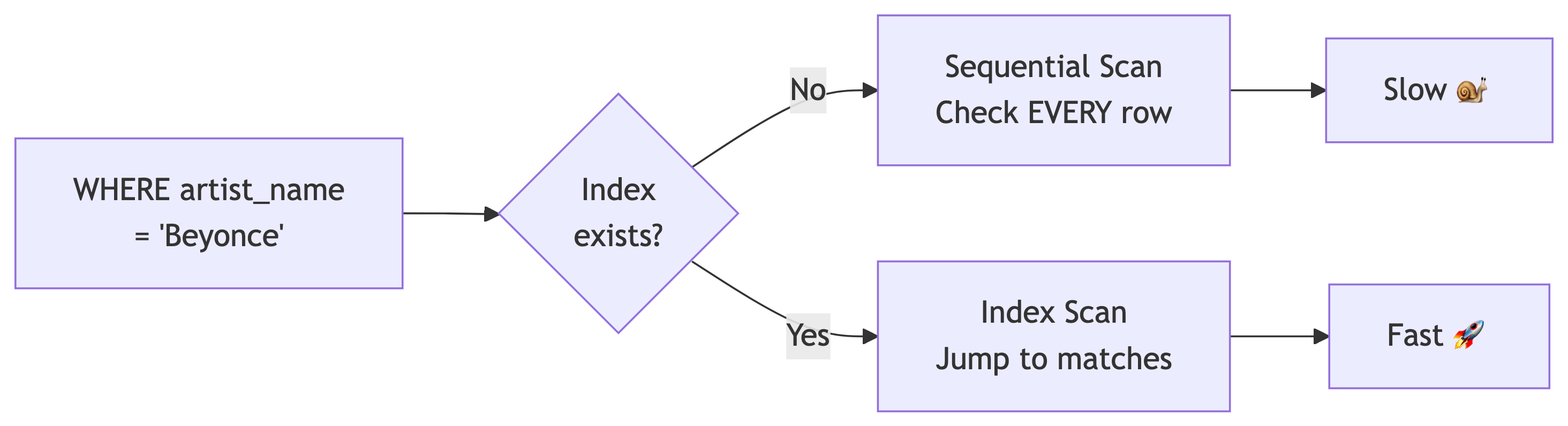
Creating Indexes
These build B-tree indexes (the default) on frequently queried columns.
When to Index
| Create Index When | Skip Index When |
|---|---|
| Column in WHERE clauses | Table is small (< 1000 rows) |
| Column in JOIN conditions | Column has few distinct values |
| Column in ORDER BY | Heavy INSERT/UPDATE load |
| Foreign key columns | You rarely query the column |
Tip
PostgreSQL automatically indexes PRIMARY KEY and UNIQUE columns. You only need to create indexes on other frequently queried columns.
The Cost of Indexes
Indexes are not free:
- They consume disk space
- They slow down INSERT, UPDATE, and DELETE
- Too many indexes hurt overall performance
Indexing everything is like highlighting every word in a textbook. At that point, nothing is highlighted. 📚🖍️
🧠 Knowledge Check 6
Which column would benefit MOST from an index?
A
notescolumn that is never used in WHERE clausesA
gendercolumn with only 3 possible valuesAn
emailcolumn frequently used in WHERE and JOINA
created_atcolumn on a table with 50 rows
Think about: Why would indexes be wasteful on the other columns?
✅ Answer: Knowledge Check 6
C) An email column frequently used in WHERE and JOIN
High selectivity + frequent queries = best index candidate.
Putting It All Together 🏗️
The Build Order

The Artists Table
Decisions:
- Surrogate key because artist names can change
artist_nameis NOT NULL and UNIQUE
The Albums Table
CREATE TABLE albums (
    album_id bigserial,
    album_title varchar(200) NOT NULL,
    release_year smallint,
    genre varchar(50),
    label varchar(100),
    duration_min numeric(5,1),
    artist_id bigint NOT NULL REFERENCES artists (artist_id),
    CONSTRAINT album_key PRIMARY KEY (album_id),
    CONSTRAINT check_year_range
        CHECK (release_year BETWEEN 1900 AND 2100),
    CONSTRAINT check_duration_positive
        CHECK (duration_min > 0),
    CONSTRAINT album_artist_unique
        UNIQUE (album_title, artist_id)
);
Decisions:
artist_idNOT NULL (every album needs an artist)- CHECK on year catches obvious errors
- Composite UNIQUE prevents duplicate albums per artist
The Tracks Table
CREATE TABLE tracks (
    track_id bigserial,
    track_title varchar(200) NOT NULL,
    track_number smallint NOT NULL,
    duration_sec numeric(6,1),
    album_id bigint NOT NULL REFERENCES albums (album_id),
    CONSTRAINT track_key PRIMARY KEY (track_id),
    CONSTRAINT check_track_number CHECK (track_number > 0),
    CONSTRAINT check_track_duration CHECK (duration_sec > 0),
    CONSTRAINT track_album_unique UNIQUE (track_number, album_id)
);
Decisions:
- Composite UNIQUE on
(track_number, album_id)prevents duplicate track numbers within an album album_idNOT NULL (orphan tracks are sad tracks 😢)
The Indexes
-- Speed up artist lookups on albums
CREATE INDEX idx_albums_artist ON albums (artist_id);

-- Speed up album lookups on tracks
CREATE INDEX idx_tracks_album ON tracks (album_id);

-- Speed up genre browsing
CREATE INDEX idx_albums_genre ON albums (genre);

-- Speed up year-based searches
CREATE INDEX idx_albums_year ON albums (release_year);
The Complete Schema
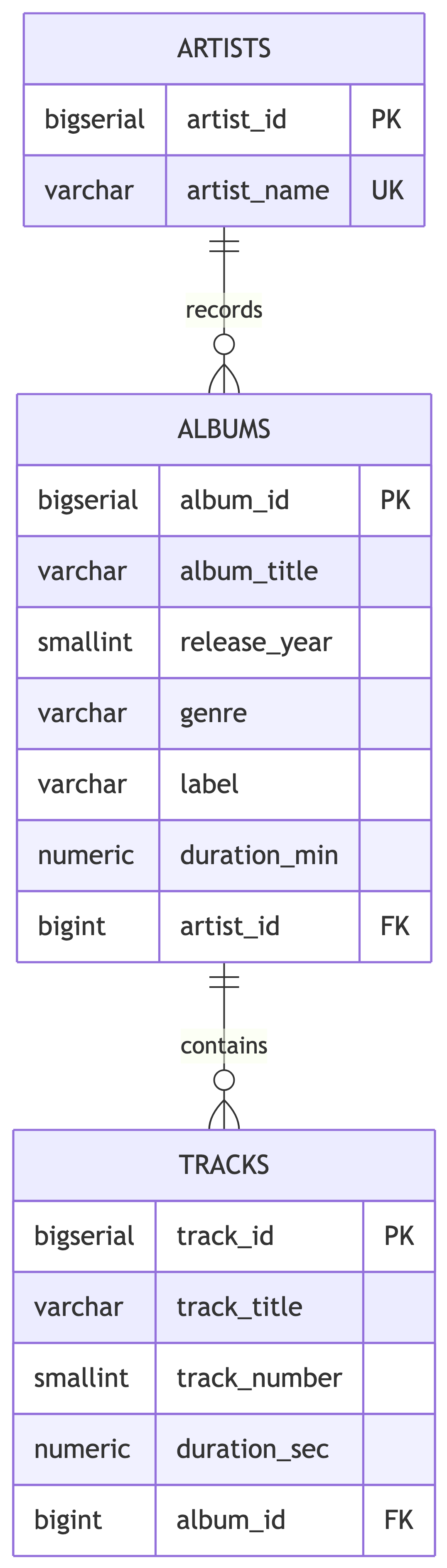
Three tables. Proper constraints. Indexes on the right columns. Ready for data. 🎶
Constraint Cheat Sheet
| Constraint | Purpose | Syntax |
|---|---|---|
| PRIMARY KEY | Unique row identifier | CONSTRAINT name PRIMARY KEY (col) |
| FOREIGN KEY | Referential integrity | col type REFERENCES table (col) |
| CHECK | Value validation | CONSTRAINT name CHECK (expr) |
| UNIQUE | No duplicates | CONSTRAINT name UNIQUE (col) |
| NOT NULL | Requires a value | col type NOT NULL |
What Is Next 🚀
Coming Up
Now that we can build tables, the next step is filling them. Next time:
- Audit the staging data for quality issues (spoiler: there are many)
- Fix inconsistencies with UPDATE
- Migrate data into our normalized tables with INSERT INTO … SELECT
- Wrap it all in transactions for safety

References 📚
Sources
DeBarros, A. (2022). Practical SQL: A Beginner’s Guide to Storytelling with Data (2nd ed.). No Starch Press. Chapter 7: Table Design That Works for You.
PostgreSQL Documentation. “CREATE TABLE.” https://www.postgresql.org/docs/current/sql-createtable.html
PostgreSQL Documentation. “Constraints.” https://www.postgresql.org/docs/current/ddl-constraints.html
PostgreSQL Documentation. “Indexes.” https://www.postgresql.org/docs/current/indexes.html